The short version
- Six carrier pricing changes hit between April 13 and May 4, 2026 — affecting UPS, FedEx, and USPS across different services and fee types.
- The USPS 8% transportation surcharge took effect April 26, 2026 and runs through January 17, 2027 — the first time USPS has ever applied a transportation-related surcharge to packages.
- The UPS April 13 change is structural, not a fuel surcharge increase. It restructures the index table and locks in a higher floor when diesel prices fall.
- Most shippers won’t feel all six changes — but the unusual pace of mid-year activity is itself the signal worth paying attention to.
- Contracts written in late 2025 are already operating in a different market. Mid-cycle is the right time to revisit them.
The U.S. parcel market typically runs on a predictable cadence. A General Rate Increase in January. Periodic fuel surcharge adjustments throughout the year. A peak season hit in October. Sophisticated shippers budget for all of it.
What’s happening right now is different — not because every shipper will feel every change, but because the pace and overlap of changes in a three-week window is unusual enough to be its own signal.
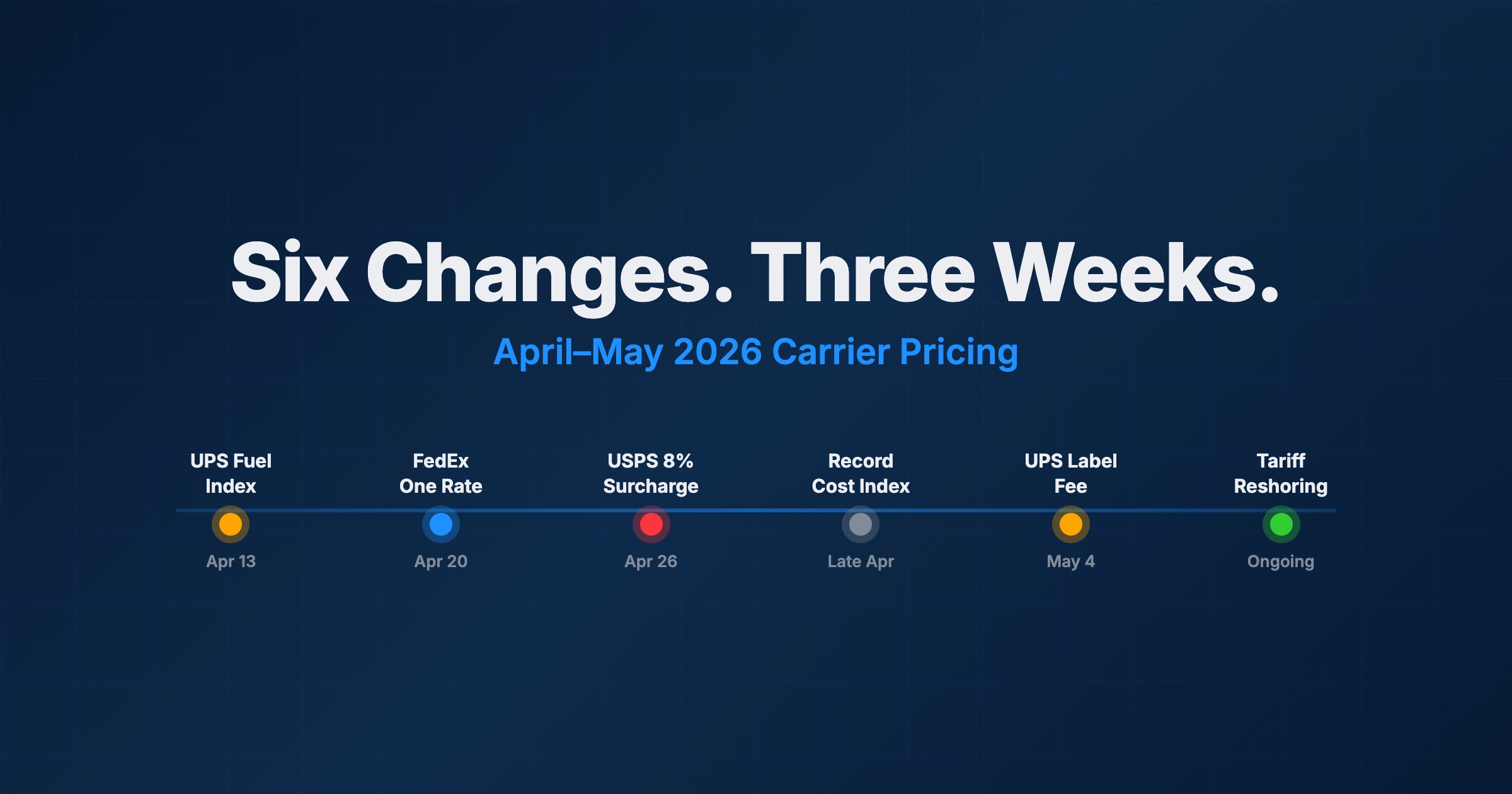
Between April 13 and May 4, 2026, six separate carrier pricing changes are hitting the market. They come from three different carriers, target different service types, and are driven by different underlying causes:
- April 13: UPS restructured its domestic fuel surcharge index table
- April 20: FedEx One Rate mid-year price increase
- April 26: USPS first-ever transportation surcharge — 8% across all parcel products
- Late April: TD Cowen/AFS Freight Index confirms Q1 2026 ground delivery costs at all-time highs
- May 4: UPS Ground Saver $5/package penalty for non-compliant labels
- Ongoing: Tariff-driven reshoring is increasing domestic parcel demand and tightening carrier capacity
Most shippers won’t be directly hit by all six. A pure-USPS shipper doesn’t care about the UPS Ground Saver labeling fee. A FedEx-only operation isn’t watching the UPS fuel index. The point isn’t that every invoice will reflect every change — it’s that this much carrier pricing activity in three weeks is a flag. The market is in a more fluid state than the published GRIs suggest, and the assumptions baked into a Q4 2025 budget aren’t holding.
What Actually Changed With UPS Fuel Surcharges on April 13, 2026?
The UPS announcement on April 13 is the change most likely to be miscategorized — including in some of the early industry coverage. UPS didn’t increase its fuel surcharge percentage that day. It restructured the underlying index table that maps diesel prices to surcharge percentages.
At today’s diesel prices — north of $5.60/gallon — the new table produces roughly the same surcharge percentage as the old one. Shippers won’t see an immediate jump on their April 13 invoices. The change becomes meaningful when fuel prices fall: the new table eliminates the lower price tiers and starts the surcharge at a higher floor. If diesel returns to the $3.70–$4.30 range it sat in for most of 2025, shippers on the new table will pay measurably more than they would have under the old one.
This is a structural change disguised as a routine table update. It’s the kind of thing carriers announce in language designed not to draw attention. And it matters because it establishes a higher permanent baseline regardless of where fuel goes from here.
Why Is the USPS 8% Transportation Surcharge a Big Deal?
For the first time in the modern era, USPS is applying a transportation-related charge to every parcel — Ground Advantage, Priority Mail, Priority Mail Express, Parcel Select. The 8% increase took effect April 26 and runs through January 17, 2027.
Technically, USPS isn’t calling it a fuel surcharge. The USPS announcement describes it as a “transportation-related, time-limited price change.” But internally, in conversations with customers, and in nearly all industry coverage, that’s how it’s being framed and discussed. The distinction matters less than the precedent.
For shippers who routed lightweight parcels to USPS specifically to avoid fuel surcharge volatility, that escape route just narrowed. And the language USPS used in its filing — describing the increase as a “bridge to the eventual implementation of a permanent mechanism” — signals that this isn’t temporary in spirit, even if it’s temporary on paper.
What’s the Macro Backdrop Driving These Changes?
All of this is happening against a backdrop that most carrier pricing announcements ignore: fuel prices are at or near all-time highs and have been since the Iran conflict disrupted Middle East oil flows in March. That’s the underlying driver behind the UPS index reset, the USPS surcharge, and most of the FedEx adjustments. None of these carriers moved in isolation. They moved because the cost basis underneath them moved.
Layered on top of that, tariffs are raising domestic shipping costs even for companies that don’t import anything. As tariff exposure on Chinese and Indian imports has increased, manufacturers have accelerated nearshoring and reshoring. That’s a supply chain decision — but it’s also a domestic logistics demand event. More domestic production means more domestic parcel volume. Tighter capacity means carriers have less reason to compete on price.
The TD Cowen/AFS Freight Index, published April 17, confirmed what the rate cards already suggested: Q1 2026 ground delivery costs hit record highs. Q2 is on track to be higher.
What makes this different from prior cycles isn’t the size of any single increase. It’s the fluidity. A normal year delivers one major pricing event in January and a handful of fuel surcharge adjustments. This year has already delivered three UPS fuel-related changes, a structural USPS shift, a FedEx One Rate mid-year hike, and a new UPS penalty fee — and we’re four months in.
How Should Mid-Market Shippers Respond?
The instinct to model “what each change costs me” is the wrong starting point. A shipper running 60% UPS Ground, 25% USPS, and 15% FedEx is exposed to all three carriers’ moves — but the actual dollar impact depends entirely on service mix, weight profile, zone distribution, and contract structure. The right question isn’t “how much will this cost me?” It’s “what does the velocity of these changes tell me about how to manage carrier relationships for the rest of 2026?”
A few things that follow from that:
Carrier contracts written in late 2025 are already operating in a different market. The fuel surcharge language, accessorial caps, and minimum charges that were negotiated against a stable cost backdrop are now being applied in a market where the backdrop is moving every few weeks. Anywhere a contract has a review clause, a renegotiation trigger, or a flexibility provision — that’s worth pulling out and reading again.
Mid-year carrier conversations have more leverage right now than they will in Q3. When USPS becomes 8% more expensive overnight, UPS and FedEx account teams know their relative pricing just got sharper. That’s a moment to revisit fuel surcharge caps, minimum package charges, and accessorial waivers — not in October when peak surcharges hit, but in May when the comparative math is freshest in the carrier rep’s mind.
The UPS Ground Saver labeling fee is the easiest one to miss and the easiest one to avoid. A $5 penalty per non-compliant package on Ground Saver volume can add up quickly for shippers running older systems. Verifying label compliance against the current UPS specification before May 4 is a one-time operational fix with a real cost-avoidance return. (For background on how Ground Saver pricing works in the first place, see our UPS Ground Saver guide.)
If your 2026 budget assumed 5–6% inflation across the board, the variance conversation needs to happen now. Not in July when the next USPS adjustment likely lands. Not in October when peak hits. Now — when there’s still room to adjust pricing, renegotiate, or reshape the carrier mix before the cost variance becomes a Q4 surprise.
The Pattern
Carriers don’t coordinate their increases. They don’t need to. They watch each other, and when one moves, the others have less reason to hold back. USPS introducing a transportation surcharge for the first time sends a signal to every carrier in the market: the floor just moved up.
The shippers who built 2026 budgets on the assumption that pricing would behave the way it did in 2024 are already operating against an outdated baseline. The ones who treated January’s GRI as the year’s pricing event — rather than the opening move in a more fluid year — are about to find that “set it in January and forget it” doesn’t work in this market.
The specific dollar impact of any single change matters less than the recognition that mid-cycle volatility is now the operating environment. Shippers who internalize that, revisit their contracts, and treat carrier pricing as something that needs active management — not annual review — will end 2026 in a meaningfully better position than the ones who don’t.
Frequently Asked Questions
When does the USPS 8% transportation surcharge take effect? The USPS 8% transportation surcharge took effect at midnight Central Time on April 26, 2026 and is scheduled to remain in place through midnight Central Time on January 17, 2027. It applies to Priority Mail Express, Priority Mail, USPS Ground Advantage, and Parcel Select. First-Class Mail and stamps are not affected.
Is the USPS 8% increase a fuel surcharge? Technically no. USPS classifies it as a “transportation-related, time-limited price change” rather than a fuel surcharge. In practice, it functions like a fuel surcharge and is being discussed as one across the industry. USPS has signaled the surcharge may serve as a “bridge to the eventual implementation of a permanent mechanism,” meaning a more formal surcharge structure could follow.
What changed with UPS fuel surcharges on April 13, 2026? UPS restructured its domestic fuel surcharge index table effective April 13, 2026. At current diesel prices (above $5.60/gallon), the new table produces approximately the same surcharge percentage as the prior one. The change becomes meaningful when fuel prices fall — the new table eliminates lower price tiers and establishes a higher minimum surcharge floor.
What is the UPS Ground Saver $5 labeling fee? Effective May 4, 2026, UPS will charge a $5.00 per-package Non-Compliant Label Fee on UPS Ground Saver shipments where the customer fails to comply with the UPS Guide to Labeling Supplement for Ground Saver, or fails to use an approved shipping system that meets current UPS requirements. Shippers should verify their label specifications before May 4 to avoid the fee.
When did the FedEx One Rate price increase take effect? FedEx One Rate pricing increased effective April 20, 2026. The mid-year adjustment affected Express Saver, 2Day, 2Day A.M., and Overnight services across One Rate packaging tiers.
How much will my 2026 shipping costs increase overall? The actual impact varies significantly by carrier mix, service profile, weight distribution, zone concentration, and existing contract terms. Most mid-market shippers should expect their effective shipping cost increases for 2026 to exceed the published 5.9% GRI by a meaningful margin once fuel surcharges, the USPS surcharge, and accessorial changes are accounted for. The right way to size the impact is to model your specific shipment data against current carrier schedules — not to apply a single percentage assumption.
What should I do about my carrier contracts right now? Mid-2026 is an unusually good moment to revisit carrier contracts. With USPS 8% more expensive overnight and fuel surcharges at multi-year highs, UPS and FedEx account teams have a clearer competitive position to negotiate against. Areas worth focusing on include fuel surcharge caps, minimum package charges, accessorial waivers, and any contract review or renegotiation clauses that may be triggerable based on the volume of mid-cycle changes.
Brandon Staton is the Founder and CEO of ShipMint, a parcel shipping optimization platform serving mid-market shippers. He has spent 17+ years in the parcel industry, has personally negotiated more than 500 carrier contracts across UPS, FedEx, DHL, USPS, and OnTrac, and has been quoted by the Wall Street Journal on parcel industry topics. ShipMint is headquartered in Raleigh, North Carolina.
#ParcelShipping #ShippingCosts #SupplyChain #Logistics #CarrierNegotiation