In video games, movies, and software, an Easter egg is something hidden in plain sight — a secret message, a bonus feature, an inside joke tucked away for the people who know where to look. Developers hide them. Fans hunt for them. The whole point is that they’re there, but you have to go looking.
FedEx just dropped an Easter egg of its own. And this one isn’t fun.
Shortly after 5 p.m. EDT on the Friday before Easter, FedEx emailed its One Rate Pricing Program customers a three-sentence notice: rates are changing, effective April 20. Check your agreement for details.
That’s it. No numbers. No percentages. No breakdown by service or packaging type. Just a pointer to a PDF that most customers won’t open until the holiday weekend is over — if they open it at all.
The Easter egg is in the agreement. A 6.9% average increase on FedEx 2Day and Express Saver base costs, effective in 17 days. You just had to know where to look.
Hidden, but Not Accidental
Carriers have a long track record of sliding rate announcements into the calendar during periods when their customers are least likely to be watching. Holiday weekends. Friday afternoons. Late in the day. The timing is never coincidental.
The logic is straightforward: the fewer eyes on an announcement, the fewer questions it generates. The fewer questions it generates, the smoother the price increase goes. By the time customers return to their desks and open the email, the news cycle has moved on, and the increase is already baked into the operational calendar.
This isn’t unique to FedEx — UPS has its own version of the holiday-weekend rate drop. But an email sent after 5 p.m. on the Friday before Easter, with the actual numbers buried in a linked PDF? That’s not an Easter egg anyone was hunting for. That’s one they were hoping no one would find.
Why One Rate Matters
FedEx One Rate was introduced as a simplified flat-rate pricing option — no dimensional weight calculations, no zone-based complexity. For lightweight e-commerce shippers, it removed the mental math and made FedEx the easy choice.
And it worked. One Rate has been one of FedEx’s most successful initiatives for capturing 2-day volume. While the program technically covers multiple service levels — Express Saver, FedEx 2Day, Standard Overnight, and Priority Overnight — its center of gravity has always been 2-day delivery. For a wide swath of e-commerce and B2B shippers, “FedEx 2Day One Rate” became the default answer to the question of how to ship a package quickly without surprises on the invoice.
That dominance in the 2-day market is exactly why FedEx can get away with this kind of announcement cadence. When your customers have already built their shipping workflows around your service, the switching cost is high. A mid-year price increase, announced on a holiday weekend with barely two weeks’ notice, isn’t a risk — it’s a bet that most customers won’t react before the new rates take effect.
What’s Actually Changing — The Numbers FedEx Didn’t Put in the Email
The email told customers to “refer to the pricing listed in your agreement.” So we did.
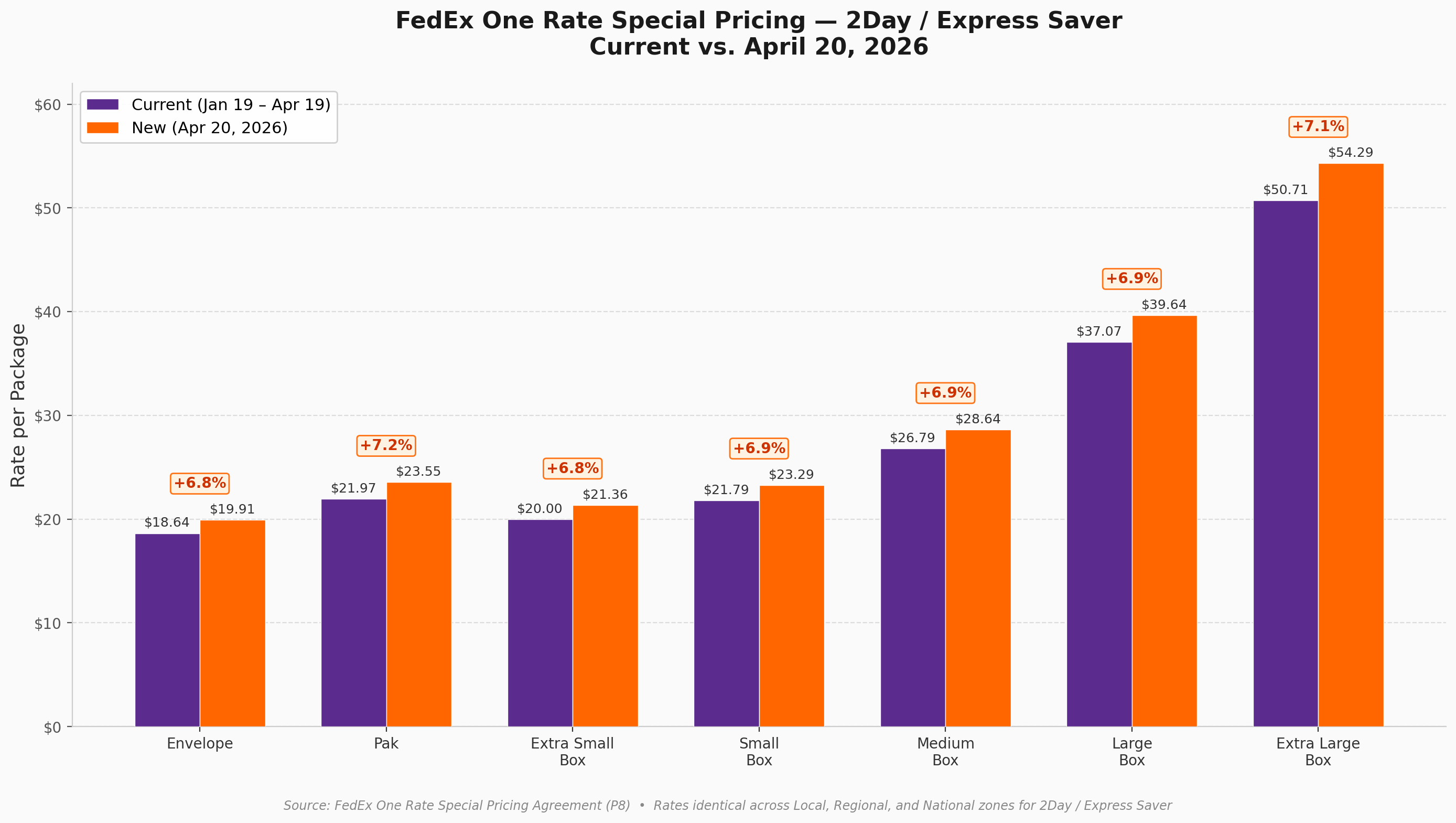
The One Rate Special Pricing agreement — the document linked to customer contracts — has been updated with rates effective April 20, 2026, alongside the current rates (effective January 19 – April 19, 2026). Here’s what that looks like for FedEx 2Day and Express Saver — the services that matter most:
| Packaging | Current | April 20 | $ Change | % Change |
|---|---|---|---|---|
| Envelope | $18.64 | $19.91 | +$1.27 | +6.8% |
| Pak | $21.97 | $23.55 | +$1.58 | +7.2% |
| Extra Small Box | $20.00 | $21.36 | +$1.36 | +6.8% |
| Small Box | $21.79 | $23.29 | +$1.50 | +6.9% |
| Medium Box | $26.79 | $28.64 | +$1.85 | +6.9% |
| Large Box | $37.07 | $39.64 | +$2.57 | +6.9% |
| Extra Large Box | $50.71 | $54.29 | +$3.58 | +7.1% |
That’s an average of 6.9% across all FedEx 2Day/Express Saver packaging types. For Priority Overnight, increases average 5.2%, ranging from $1.09 on an Extra Small Box to $3.57 on an Extra Large Box.
These are the One Rate Special Pricing rates — a base cost (before discount) that is separate from FedEx’s standard published list rates. Customer incentives are calculated against this base. When FedEx raises it, every One Rate shipment gets more expensive, even if your discount percentage stays the same. A customer with a 15% incentive off the old base and a 15% incentive off the new base is still paying more — they’re just paying 15% less of a bigger number.
This is the mechanism that makes these increases particularly effective. They don’t show up as a change in your contract terms. They show up as a change in the base costs your contract references. If you’re not watching those base costs, you won’t notice until the invoices arrive.
What We’re Hearing from Customers
We’re hearing from One Rate customers — especially those with aggressive discounts — that FedEx is taking a much harder line than usual when it comes to rate negotiations and incentive renewals. Requests to offset the base cost increases with improved incentives are being met with more resistance than in prior years.
This is likely connected to historically high fuel costs. Here’s the part that makes this particularly frustrating for One Rate customers: fuel is already factored into FedEx One Rate pricing. It’s bundled into the flat rate. So when fuel costs rise, FedEx is absorbing that increase on paper — but then recovering it through base cost increases like this one. The customer ends up paying for the fuel increase anyway, just through a different line item.
What Shippers Should Be Doing
If you’re on the One Rate Pricing Program, this is your 17-day window. It’s already shorter than 17 days if you count the holiday weekend you just lost.
Here’s what matters:
1. Pull the new rate table. The updated One Rate Special Pricing agreement already has the April 20 rates published side-by-side with the current rates. You can see exactly what’s changing in base costs on a per-package, per-packaging-type basis.
2. Don’t confuse the retail rate PDF with your contract rate. One Rate customers ship against a contract-specific base cost (before discount), not the retail rate table. The One Rate Pricing PDF on FedEx’s rate changes page is a different document with different numbers than the Special Pricing agreement your incentives are applied against.
3. Model the impact before it hits. Don’t just look at the rate table — model the increase on the net costs of your actual mix. If you shipped 10,000 One Rate FedEx 2Day Small Boxes last quarter at a $21.79 base, your new base is $23.29. After your discount, that’s still a meaningful per-package increase that compounds across your entire volume. Run the numbers on what you actually ship.
4. Talk to your FedEx rep — but know what you’re asking for. A call that says “I saw rates are going up, what can you do?” will get you nothing. A call that says “I’ve modeled the impact of the new One Rate base costs against my volume, and I need to discuss adjusting my incentive to offset the increase” is a different conversation entirely. Be prepared for pushback — reps are holding the line tighter than we’ve seen in recent history.
5. Evaluate whether One Rate is still the right structure. For some customers, the simplicity premium of One Rate may no longer justify the cost — especially if your average package weight and dimensions would price more favorably under standard rates with proper dimensional weight optimization.
The Bigger Picture
This is the fourth One Rate adjustment in less than a year. FedEx changed FedEx 2Day and Express Saver rates in July 2025, increased the Special Pricing base in October 2025, updated rates again in January 2026 (adding the Extra Small Box), and now a full 6.5% average increase in April 2026.
The frequency tells you something. One Rate has become a significant enough revenue line that FedEx is managing it actively — and aggressively. The days of One Rate as a stable, set-it-and-forget-it pricing option are over.
For shippers who built their operations around the simplicity of One Rate, the question isn’t whether to stay on the program. It’s whether you’re actively managing it — or whether you’re the customer FedEx is counting on to not open the email until it’s too late.