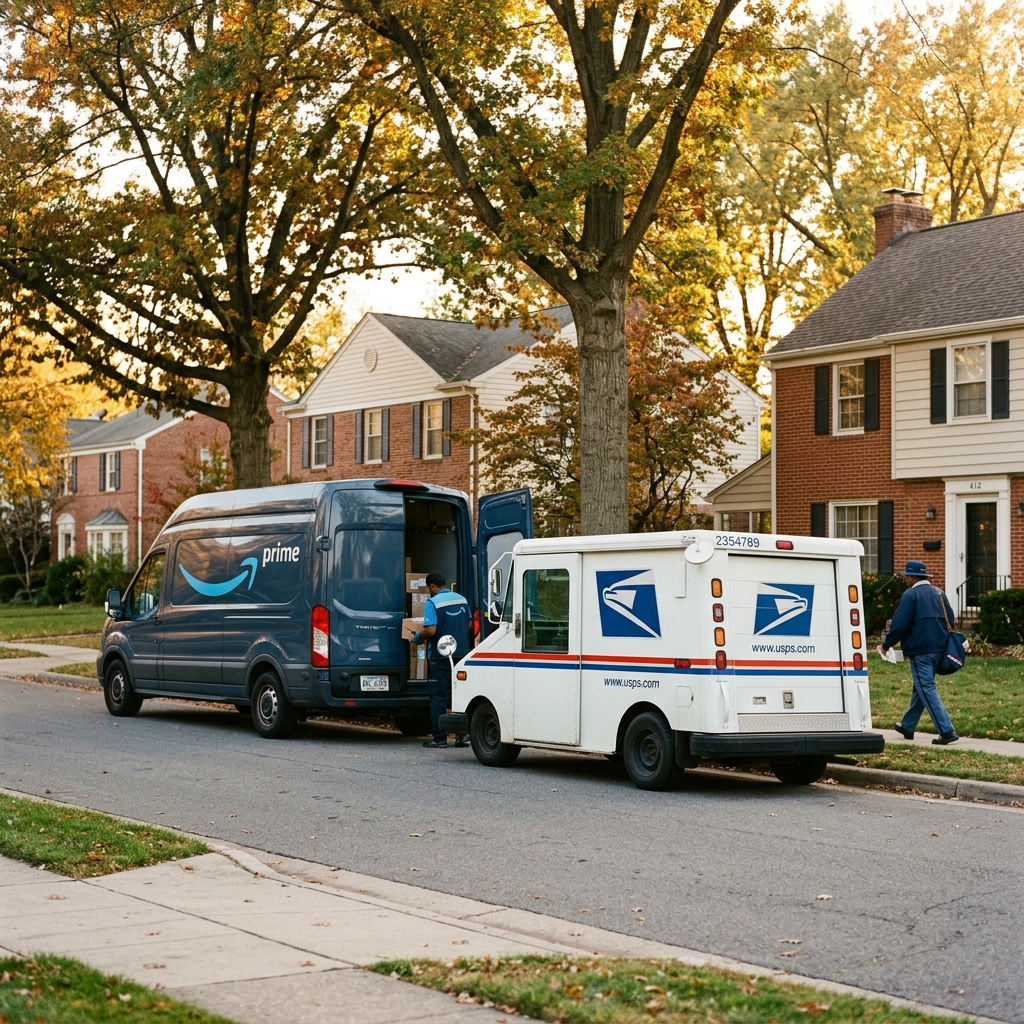
The headline reads like a win for both sides: Amazon and the USPS reach a new agreement, preserving 80% of package volume, averting catastrophe for the Postal Service, and giving Amazon a measured off-ramp.
But headlines don’t negotiate deals. People do. And the details of this one tell a much more interesting story about leverage, ambition, and the uncomfortable reality of what the U.S. Postal Service actually is.
Amazon Won This Negotiation
Let’s start with the obvious: Amazon outclassed the USPS at the bargaining table.
In March, Amazon threatened to pull two-thirds of its volume from the Postal Service. That’s roughly $4 billion in annual revenue — from a single customer. The threat was credible because Amazon has spent years and billions of dollars building its own delivery network: 4,400+ Delivery Service Partners, 390,000+ drivers, 40,000+ semi-trucks, 60,000+ trailers, and roughly 100 aircraft. Amazon Logistics delivered an estimated 6.7 billion packages in 2025 and handled approximately 28% of all U.S. packages in 2024. This is not a company bluffing about its ability to deliver its own packages.
The Postal Service blinked. The final deal cuts volume by 20%, not 66%.
That is a negotiation victory for Amazon, achieved through a position of genuine strength. The fact that Amazon could make a two-thirds reduction threat and be taken seriously is itself an extraordinary accomplishment. Five years ago, that threat would have been laughable. Today, it moved the most politically protected logistics organization in the country.
But here’s the thing: Amazon settled.
The Safety Net Amazon Still Needs
If Amazon could fully replace the USPS, it would have. The economics of self-delivery at scale — no middleman margin, full control of the customer experience, proprietary data on every package — are too compelling for a company like Amazon to voluntarily share with anyone.
The fact that Amazon negotiated to keep 80% of its volume with the USPS, rather than pulling the trigger on the larger cut, tells you something important: Amazon’s network isn’t ready. Not for all of it. Not yet.
The 20% Amazon is pulling back is almost certainly concentrated in the markets where Amazon feels most confident — dense population centers where its DSP network has reached critical mass, where route density justifies the infrastructure, and where delivery economics already favor self-delivery. These are the metros where Amazon vans are on every street corner and three delivery waves a day are the norm.
The 80% that stays with the USPS? That’s the hard stuff. Rural routes where a single driver covers 200 miles to hit 30 stops. Suburban sprawl where the density doesn’t justify Amazon’s cost per stop. Small towns where the USPS carrier is the only delivery vehicle that shows up every day, six days a week, because the law requires it.
In the USPS, Amazon has a safety net that allows it to gradually expand its own network without the risk of going all-in. Amazon can cherry-pick the dense, profitable routes — pulling 20% now, maybe 30% next year, maybe 40% the year after — while leaving the expensive, low-density stops with the Postal Service. It’s a deliberate, low-risk strategy for network expansion, and it’s exactly what a company with Amazon’s resources and patience would do.
The USPS, for its part, gets to keep the volume that nobody else wants to carry anyway.
A Lifeline — or a Tightening Leash?
Some are framing this deal as a lifeline for the Postal Service. In the near term, that’s fair. Losing 20% of Amazon’s volume is painful — roughly $1.2 billion in annual revenue — but it’s survivable. Losing 66% would have been existential.
But lifelines can also be leashes. The USPS is now more dependent than ever on retaining the Amazon volume it has left. And Amazon — having demonstrated that it can credibly threaten to leave — now holds permanent leverage over future negotiations. Every contract renewal, every rate discussion, every service-level disagreement will carry the implicit threat of further volume reduction. Amazon doesn’t need to say it. The USPS will feel it.
This is the asymmetry that defines the relationship: Amazon can survive without the USPS. The USPS cannot survive without Amazon — at least not in its current financial condition.
The Ground Advantage Problem
The Amazon deal doesn’t exist in isolation. The Postal Service is simultaneously navigating significant challenges with its Ground Advantage NSA program — the aggressive pricing initiative designed to pull parcel volume from UPS and FedEx.
The Ground Advantage NSA rollout has been, to put it diplomatically, uneven. Customers were onboarded with competitive pricing and the promise of operational sophistication that the Postal Service was not yet equipped to deliver. Data systems couldn’t produce reliable invoice information. Mailer IDs and CRIDs created integration headaches. The Business Gateway — USPS’s customer-facing data portal — remains inaccessible or unreliable for many shippers. Pickup operations were improvised rather than scaled. And critically, many NSA customers were sold on the premise that their rates were fixed — only to be hit with the 8% fuel surcharge weeks later.
The technology and support gap is real. The Postal Service’s infrastructure is not built for the level of sophistication that modern parcel shippers require. Invoicing formats are inconsistent. Reporting tools are limited. Customer support is well-intentioned but often unable to resolve operational issues because the institutional knowledge simply isn’t there.
These aren’t growing pains. These are structural limitations. And for shippers evaluating their carrier mix, they factor into the total cost of doing business with the USPS — a cost that doesn’t appear on any rate table.
DHL eCommerce: The Next $10 Billion Bet
While Amazon was negotiating from a position of strength, DHL eCommerce was negotiating from a position of commitment.
DHL is in the late stages of finalizing a five-year, $10 billion agreement with the USPS — $2 billion per year in committed volume. The deal, which sources indicate could be signed before the National Postal Forum in early May, would be the longest agreement of its kind between the USPS and a major mailer.
DHL pushed for the five-year term because it plans to invest $400–500 million in network infrastructure and needed the long-term certainty to justify that capital expenditure. For a company to commit a half-billion dollars in network investment, it needs to know the foundation isn’t going to shift underneath it midway through the build.
The DHL deal reinforces a pattern: the USPS remains the essential last-mile partner for large mailers, even as those mailers invest in their own sorting, processing, and regional distribution capabilities. DHL, like Amazon, is building out its own network — but it still needs the USPS for the final leg of delivery. The Postal Service’s six-day, every-address delivery mandate is something no private carrier can replicate, and no private carrier wants to.
But the DHL deal also highlights a tension. The 8% price increase that took DHL off guard was not part of DHL’s contract negotiations. It arrived separately, after months of negotiation, and it caught DHL in a difficult position — unable to pass the cost through to its own customers within the standard 30-day notification window. DHL is now pushing the USPS for relief: a full waiver, a reduction, or at minimum a delay. The outcome of that push will signal whether USPS treats its largest committed partners differently from the broader market — or whether the 8% truly is non-negotiable for everyone.
The Question Nobody Will Answer: Business or Service?
The fundamental question about the United States Postal Service is one that Congress has refused to definitively answer for decades: Is it a business, or is it a service?
The financial commentary treats it as a business. How much money is the Post Office losing? What’s the operating deficit? Why can’t it cover its costs? These are fair questions — if you’re evaluating a business.
But the USPS operates under constraints that no business would accept. Universal delivery obligations. Six-day service mandates. Regulated pricing through the PRC. A workforce compensated and managed under federal employment rules, not market-driven ones. Pre-funding requirements for retiree health benefits that no private company is required to match.
The way USPS employees are compensated, the hours they work, and the regulatory framework they operate under all point in one direction: this is a public service. The people who deliver the mail are public servants. The infrastructure that supports them is public infrastructure. The mandate that every address in America receives mail service — regardless of profitability — is a service mandate, not a business imperative.
And yet, the USPS is told to operate like a business. Cover your costs. Compete with FedEx and UPS. Win parcel volume. Negotiate contracts. Build a competitive pricing model. Justify your workforce to Congress every year.
These two frameworks — business and service — are in direct conflict. A service prioritizes coverage, reliability, and access. A business prioritizes margin, efficiency, and return on investment. You cannot optimize for both simultaneously, and the attempt to do so is the root cause of nearly every challenge the USPS faces today.
The Ground Advantage NSA program is a perfect example. It was a business strategy — aggressive pricing to win volume from private carriers. But it was executed within a service framework — limited technology, a workforce not incentivized to sell or retain accounts, and a leadership structure accountable to Congress rather than shareholders. The result was predictable: the strategy attracted volume the infrastructure couldn’t support, and the customers who signed up expecting a business-class experience got a public-service one.
Until Congress takes a definitive stance — either adequately funding the USPS as the public service it functionally is, or truly liberating it to operate as the competitive business it’s being asked to be — it’s hard to imagine either path reaching its full potential. The current state is the worst of both worlds: business expectations with service constraints. And the customers, employees, and taxpayers are all paying for the ambiguity.
What This Means for Shippers
Amazon’s move isn’t just about Amazon. The 20% reduction signals the company’s future direction. That number will grow. Amazon will continue absorbing its own delivery volume in dense markets while leaning on the USPS for everything else. Shippers should watch this trend closely — not because it directly affects their USPS rates, but because it illustrates how the largest shipper in the world evaluates the risk of carrier dependency.
The USPS 8% increase is now happening in context. It’s not just a temporary price increase anymore. It’s a price increase on a carrier that just lost 20% of its largest customer’s volume, is navigating a problematic NSA program rollout, and is fundamentally uncertain about its own identity. The 8% is a symptom, not a cause.
DHL’s five-year deal raises the floor. A $10 billion, five-year commitment — if it closes — signals that major mailers believe the USPS will remain a viable last-mile partner for at least the next half-decade. That’s meaningful reassurance for smaller shippers who rely on the same infrastructure.
Carrier diversification is not optional. The days of building a shipping strategy around a single carrier — any carrier — are over. Amazon just demonstrated that even the world’s most formidable logistics operation maintains multiple carrier relationships. If Amazon isn’t going all-in on self-delivery, no mid-market shipper should be going all-in on a single carrier either.
The game didn’t change yesterday. It’s been changing for years. Yesterday just made it harder to ignore.