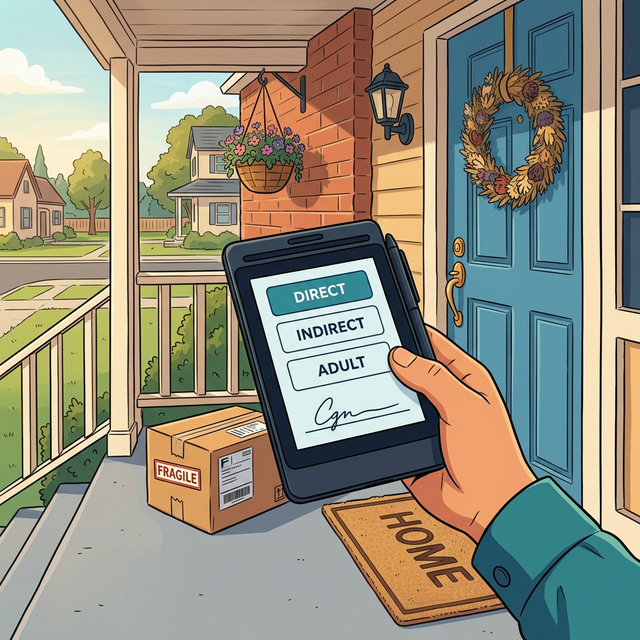
Types of Delivery Signature Options
Carriers offer multiple levels of delivery signature service, each with different requirements and costs:
2026 Signature Surcharges
| Signature Type | UPS | FedEx |
|---|---|---|
| Indirect Signature Required | $7.15 | $7.15 |
| Direct Signature Required | $7.15 | $7.15 |
| Adult Signature Required | $8.65 | $8.65 |
What Each Signature Type Means
Indirect Signature Required
The driver can obtain a signature from anyone at the delivery address or a neighbor, or leave the package at a location designated by the recipient. This is the most flexible option — the driver can release the package with a signature from someone nearby.
Direct Signature Required
The driver must obtain a signature from someone at the delivery address specifically. A neighbor’s signature is not sufficient. If no one is available, the driver will attempt redelivery.
Adult Signature Required
The driver must obtain a signature from an adult (21+) at the delivery address. The driver is required to verify a government-issued ID. This is the most restrictive and expensive option.
When Signatures Are Required
By Carrier Policy
- Packages with declared value over $500 (UPS) or $500 (FedEx) automatically require a signature
- International shipments often require signatures for customs clearance
- Certain service levels (e.g., UPS Next Day Air Early) include signature by default
By Regulation
- Alcohol shipments: Adult signature required by law in all states
- Firearms and ammunition: Adult signature required by ATF regulations
- Pharmaceuticals: Signature requirements vary by state and product
- High-value electronics: Many retailers require signatures for items over $200-$300
By Shipper Choice
Many shippers add signature requirements for:
- High-value items to prevent delivery theft claims
- Items with high fraud/chargeback rates
- B2B shipments where proof of delivery is needed for invoicing
The Cost-Benefit Analysis
Signature requirements add direct cost per package, but can reduce or eliminate other costs:
| Cost Factor | Without Signature | With Signature |
|---|---|---|
| Surcharge | $0.00 | $7.15–$8.65 |
| Missing package claims (rate) | 1–3% | 0.1–0.3% |
| Average claim payout | $35–$75 | $35–$75 |
| Chargeback rate (high-value) | 0.5–2% | < 0.1% |
For high-value items, the $7.15 signature surcharge is almost always cheaper than absorbing 1–2% loss/theft rates. The break-even point is typically around $250–$350 in product value.
Strategies to Manage Signature Costs
1. Use Value-Based Thresholds
Only require signatures on orders above a dollar threshold where the fraud/theft risk justifies the cost. Many shippers use $150–$250 as the cutoff.
2. Offer Customer Choice
Let customers opt in to signature confirmation at checkout, either absorbing the cost or passing it through as an add-on fee.
3. Use Package Release Authorization
For known addresses or repeat customers, use carrier release authorization to waive signature requirements. UPS My Choice and FedEx Delivery Manager let recipients pre-authorize release.
4. Negotiate Signature Rates
Signature surcharges are negotiable, particularly for shippers who use them at high volume:
| Published | Negotiated | Savings |
|---|---|---|
| $7.15 | $5.00 | 30% |
| $8.65 (adult) | $6.50 | 25% |
5. Consider Insurance Instead
For many shippers, purchasing shipping insurance or using a service like Shipsurance/Route is cheaper than requiring signatures on every package.
The Bottom Line
Signature options are a cost-effective loss prevention tool for high-value shipments, but they’re unnecessary for low-value items where theft claims are rare. The key is matching the right signature level to the right products — not defaulting to signature-required on everything.
Want to see your signature surcharge spend? Upload one invoice to ShipMint’s Instant Analysis for a surcharge-by-surcharge breakdown — free.