The Cost of Oversized Packaging
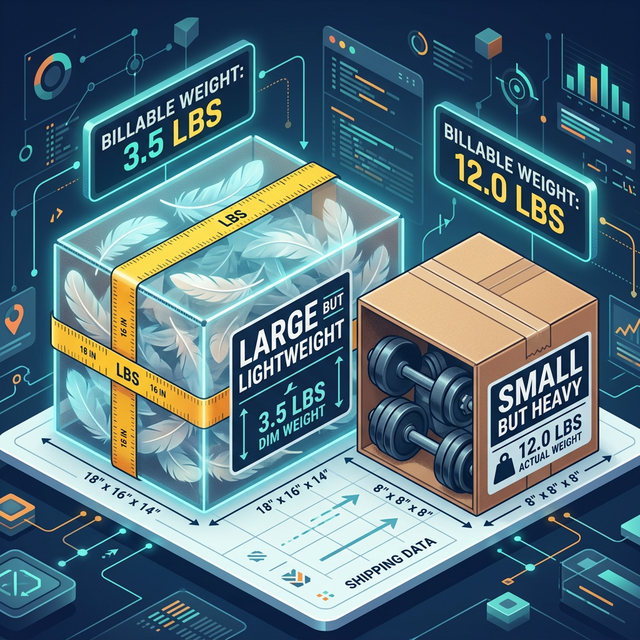
Every cubic inch of empty space inside your shipping box costs you money. When a package’s DIM weight exceeds its actual weight, you’re paying to ship air.
The DIM weight formula (L × W × H ÷ 139) means even small reductions in box dimensions compound significantly:
Example: Reducing one dimension by 2 inches
| Box Size | DIM Weight | vs. Original |
|---|---|---|
| 18” × 14” × 12” | 22 lbs | Baseline |
| 18” × 14” × 10” | 19 lbs | -14% |
| 16” × 14” × 10” | 17 lbs | -23% |
| 16” × 12” × 10” | 14 lbs | -36% |
A 36% reduction in DIM weight translates directly to a 36% reduction in base shipping cost for DIM-affected packages.
Packaging Optimization Strategies
1. Add Intermediate Box Sizes
Most shippers stock 3–5 box sizes. Adding 2–3 intermediate sizes can dramatically reduce average void space:
| # of Box Sizes | Average Void Space |
|---|---|
| 3 sizes | 35–45% |
| 5 sizes | 25–30% |
| 8 sizes | 15–20% |
| Custom/on-demand | < 5% |
2. Use Poly Mailers for Non-Fragile Items
Poly mailers conform to the product shape, effectively eliminating DIM weight for soft goods:
- Apparel
- Accessories
- Soft home goods
- Non-fragile small items
A $15 Ground shipment in a box may cost $8 in a poly mailer for the same product.
3. On-Demand Packaging Systems
Systems from companies like Packsize, Ranpak, and Sealed Air create custom-sized boxes for each order:
- Measure the contents
- Create a box that fits within 0.5”
- Eliminate virtually all void space
The equipment investment pays for itself quickly for shippers over 500 packages/day.
4. Eliminate Unnecessary Void Fill
If you’re using 4” of bubble wrap in a box that already fits well, consider whether the protection is actually needed. Many products ship safely with minimal or no void fill in a right-sized box.
5. Re-Evaluate Product Packaging
Sometimes the product packaging itself (retail box, inner packaging) can be redesigned to reduce the shipping box size:
- Remove redundant inner boxes
- Use flat-pack design where possible
- Reduce product packaging dimensions
Measuring the Opportunity
To calculate your DIM weight savings opportunity:
- Pull your shipping data for the past 3–6 months
- Identify DIM-affected packages (where billable weight > actual weight)
- Calculate the DIM premium — the difference between DIM-billed and actual-weight billing
- Estimate savings — how much would you save if those packages were right-sized?
A shipper with 50% DIM-affected packages and an average DIM premium of 8 lbs can save $1.50–$3.00 per affected package through right-sizing. At 5,000 packages/month, that’s $3,750–$7,500/month in savings.
The ROI of Packaging Changes
| Initiative | Implementation Cost | Typical Savings |
|---|---|---|
| Add 2–3 box sizes | $500–$1,000 | 10–15% on DIM packages |
| Switch to poly mailers | $200–$500 | 30–50% on eligible items |
| On-demand packaging | $15,000–$50,000 | 20–35% on all shipments |
| Packaging redesign | $5,000–$20,000 | 15–25% on affected products |
The first two initiatives are low-cost, high-impact and should be implemented first.
The Bottom Line
Right-sizing packaging is the single most cost-effective shipping optimization available to most shippers. Unlike rate negotiations (which require carrier approval) or service changes (which affect delivery speed), packaging changes are entirely within your control and can be implemented immediately. Start by auditing your DIM weight percentage — if it’s above 30%, there’s money to be saved.
Want to see your DIM weight percentage? Upload one invoice to ShipMint’s Instant Analysis — free.