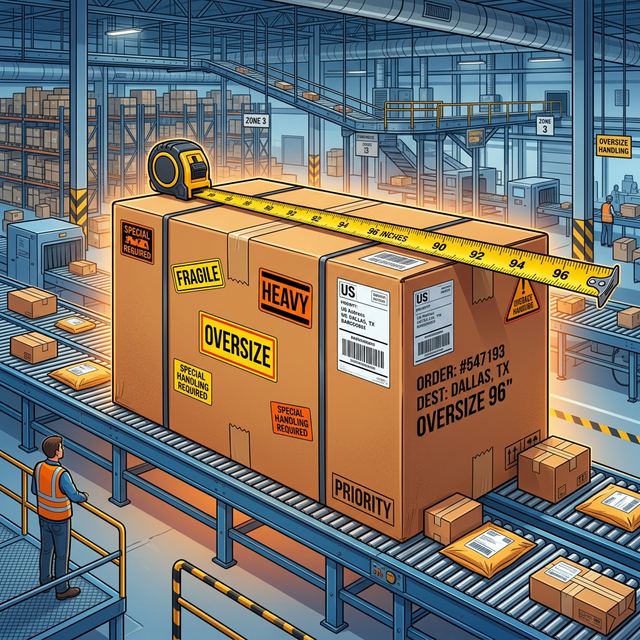
What Is an Oversize Surcharge?
An oversize surcharge is a steep per-package fee applied to packages that exceed the carrier’s maximum dimension thresholds. These are the largest packages that parcel carriers will handle — anything bigger must ship as freight.
Oversize surcharges are significantly higher than Additional Handling Surcharges and can make parcel shipping economically unviable for large items.
Oversize Thresholds and Rates
UPS Oversize (Large Package Surcharge)
| Trigger | Threshold |
|---|---|
| Length + Girth | > 130 inches |
| Actual weight | > 70 lbs |
| Cubic volume | > 5,184 cubic inches |
| 2026 Surcharge | $115.00 per package |
Girth formula: 2 × (Width + Height)
Example: A box measuring 50” × 20” × 20”
- Length = 50”
- Girth = 2 × (20 + 20) = 80”
- Length + Girth = 130” — right at the threshold
FedEx Oversize
| Trigger | Threshold |
|---|---|
| Actual weight | > 110 lbs |
| Cubic volume | > 1,728 cubic inches (Oversize) |
| Cubic volume | > 10,368 cubic inches (Additional Handling) |
| 2026 Oversize Surcharge | $115.00–$150.00 per package |
FedEx also uses cubic volume (L × W × H) as an additional trigger, which means even moderately-sized but bulky packages can qualify.
Maximum Package Size
Both carriers have absolute maximums beyond which they will not accept the package:
| Carrier | Maximum Weight | Maximum Length | Maximum L + Girth |
|---|---|---|---|
| UPS | 150 lbs | 108” | 165” |
| FedEx | 150 lbs | 108” | 165” |
Packages exceeding these limits must ship via LTL freight or specialized carriers.
The Cost Impact
Oversize surcharges are among the highest per-package charges in parcel shipping. Combined with other surcharges, they can double or triple the cost:
Example: Oversize package, 75 lbs, Zone 6
| Charge | Amount |
|---|---|
| Base rate (Ground, 75 lbs, Zone 6) | $52.00 |
| Fuel surcharge (8.5%) | $4.42 |
| Oversize surcharge | $115.00 |
| Residential delivery | $6.95 |
| Total | $178.37 |
The oversize surcharge alone is more than double the base transportation charge.
DIM Weight and Oversize: The Double Hit
Oversize packages are frequently subject to DIM weight pricing as well, since their dimensions produce very high DIM weights:
A box measuring 48” × 24” × 24”:
- DIM weight: (48 × 24 × 24) ÷ 139 = 199 lbs (rounded up)
- If actual weight is 45 lbs, you’re billed at 199 lbs for the base rate
- Plus the oversize surcharge on top
This means you’re paying the rate for a very heavy package (DIM weight) plus the oversize fee.
When to Switch to Freight
For packages that consistently trigger oversize surcharges, LTL (Less-Than-Truckload) freight may be cheaper:
| Shipping Method | Approximate Cost (75 lbs, Zone 6) |
|---|---|
| UPS Ground + Oversize | $170–$180 |
| FedEx Ground + Oversize | $175–$190 |
| LTL Freight | $120–$160 |
The crossover point varies by lane and weight, but as a general rule: if a package triggers both oversize surcharges and DIM weight above 100 lbs, price it as freight before defaulting to parcel.
How to Reduce Oversize Charges
1. Redesign Packaging
Can the product ship in a smaller form factor? Flat-pack furniture, for example, avoids oversize triggers by shipping disassembled.
2. Ship in Multiple Boxes
Sometimes splitting a large item into two smaller packages avoids oversized while staying under Additional Handling thresholds.
3. Negotiate the Surcharge
High-volume shippers with consistently large packages can negotiate reduced oversize rates — though carriers are less flexible here than on smaller surcharges.
4. Explore Specialty Carriers
Companies like FreightPros, Estes, and SEKO specialize in items that fall between parcel and traditional freight — sometimes called “white glove” or “threshold delivery” services.
The Bottom Line
Oversize surcharges are punitive by design — carriers don’t want oversized packages in their parcel networks. At $115–$150 per package, any item that consistently triggers this surcharge should be evaluated for alternative shipping methods. Freight, specialty carriers, or product re-engineering may all offer better economics than absorbing the surcharge.
Want to identify oversize charges in your shipping data? Upload one invoice to ShipMint’s Instant Analysis for a complete surcharge breakdown — free.