The Basics: What Determines Your Shipping Cost?
Every parcel shipment’s cost is built from the same fundamental components, whether you’re shipping with UPS, FedEx, or any other carrier. Understanding these building blocks is the first step toward controlling your shipping spend.
At its core, parcel pricing is determined by four factors:
- Service level — How fast does the package need to get there?
- Weight — How heavy is the package (actual or dimensional)?
- Zone — How far is the package traveling?
- Surcharges — Do any special conditions apply?
Let’s break each one down.
Service Level: Speed Costs Money
Carriers offer a range of service levels, from overnight delivery to standard ground shipping. The faster the service, the higher the base rate.
| Service Tier | Typical Transit | Cost Relative to Ground |
|---|---|---|
| Next Day Air (Early AM) | Next business day, morning | 5–8× higher |
| Next Day Air | Next business day, end of day | 4–6× higher |
| 2nd Day Air | 2 business days | 2–3× higher |
| 3 Day Select | 3 business days | 1.5–2× higher |
| Ground | 1–5 business days | Baseline |
| Economy / SurePost | 2–8 business days | 10–30% lower |
For most e-commerce and B2B shippers, Ground service handles 70–85% of volume. Express services are reserved for time-sensitive or high-value shipments.
Weight: Actual vs. Dimensional
Carriers charge based on the greater of actual weight or dimensional weight. This is one of the most important concepts in parcel shipping.
Actual weight is simply what the package weighs on a scale.
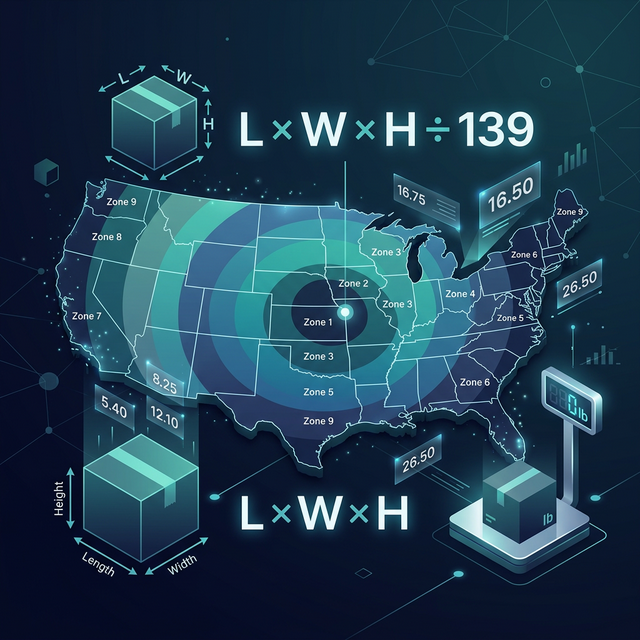
Dimensional weight (DIM weight) is calculated using the package’s dimensions:
DIM Weight = (Length × Width × Height) ÷ DIM Divisor
Both UPS and FedEx use a DIM divisor of 139 for domestic shipments (in inches/pounds). This means a box measuring 18” × 14” × 12” has a DIM weight of:
(18 × 14 × 12) ÷ 139 = 21.8 lbs (rounded to 22 lbs)
If the actual weight of that box is only 8 lbs, you’ll be charged for 22 lbs — the dimensional weight. This is why right-sizing your packaging is so critical.
Zones: Distance Determines Cost
Shipping zones range from Zone 2 (local, same metro area) to Zone 8 (cross-country). Alaska and Hawaii are typically Zone 9+.
Zones are determined by the distance between your origin zip code and the destination zip code. Each carrier publishes zone charts that map this relationship.
| Zone | Approximate Distance | Example |
|---|---|---|
| Zone 2 | 0–150 miles | Charlotte, NC to Greensboro, NC |
| Zone 3 | 150–300 miles | Charlotte, NC to Atlanta, GA |
| Zone 4 | 300–600 miles | Charlotte, NC to Washington, DC |
| Zone 5 | 600–1,000 miles | Charlotte, NC to Chicago, IL |
| Zone 6 | 1,000–1,400 miles | Charlotte, NC to Denver, CO |
| Zone 7 | 1,400–1,800 miles | Charlotte, NC to Phoenix, AZ |
| Zone 8 | 1,800+ miles | Charlotte, NC to Los Angeles, CA |
Key insight: Shipping the same 10 lb package from Zone 2 to Zone 8 can cost 2–3× more just based on distance. Understanding your zone distribution helps you plan warehouse locations and set shipping expectations.
Surcharges: The Hidden Multiplier
Base transportation charges typically represent only 55–70% of your total shipping cost. The rest comes from surcharges.
Common surcharges include:
- Fuel surcharge — A percentage added to every shipment, updated weekly based on diesel/jet fuel prices. Currently ranges from 7–25% of the base rate.
- Residential delivery — $6.45–$6.95 per package for deliveries to home addresses.
- Delivery Area Surcharge (DAS) — $3.50–$5.50+ for deliveries to rural or extended areas.
- Additional handling — $16–$40 for overweight (>50 lbs), oversized, or non-standard packages.
- Address correction — $18–$21 when the carrier corrects an invalid or incomplete address.
We cover each surcharge in detail in our dedicated surcharge articles.
Published Rates vs. Negotiated Rates
The rates in the carrier’s published rate guide are the starting point, not the ending point. Virtually every business shipper negotiates discounted rates.
- Published (list) rates: What you’d pay with no contract — the highest possible price.
- Negotiated rates: Discounts off published rates, typically 15–60%+ depending on volume.
- Earned discounts: Additional volume-based incentives that kick in as you ship more.
If you’re shipping more than ~50 packages per week and haven’t negotiated your rates, you’re almost certainly overpaying.
Putting It All Together: A Sample Rate Calculation
Let’s walk through a real example:
Shipment: 12 lb package, 18” × 14” × 8”, shipping Ground from Charlotte, NC to Chicago, IL (Zone 5)
- DIM weight: (18 × 14 × 8) ÷ 139 = 14.5 → rounded to 15 lbs
- Billable weight: Max(12, 15) = 15 lbs (DIM weight wins)
- Base rate (2026 published): ~$16.35 for Ground, 15 lbs, Zone 5
- Fuel surcharge (8.5%): +$1.39
- Residential surcharge: +$6.95
- Total: $24.69
With a 40% negotiated discount on the base rate, that same shipment drops to:
- Discounted base: $16.35 × 0.60 = $9.81
- Fuel (8.5%): +$0.83
- Residential: +$6.95
- Total: $17.59 — a 29% savings
Notice that surcharges aren’t always discounted the same way as base rates, which is why they represent a growing share of total cost.
What This Means for Your Business
Understanding how pricing works gives you the foundation to:
- Right-size packaging to avoid DIM weight penalties
- Negotiate smarter by knowing which levers move the needle
- Choose services strategically — not every shipment needs express
- Audit invoices to catch billing errors (they happen more than you’d think)
- Optimize warehouse locations to reduce average zone distance
Want to see exactly where your shipping spend is going? Upload one invoice to ShipMint’s Instant Analysis tool and get a complete cost breakdown in under 60 seconds — free.