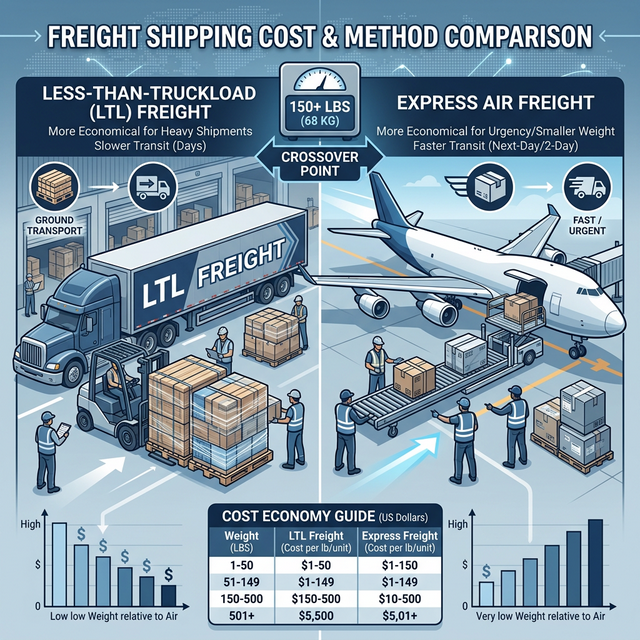
Two Types of “Freight” at FedEx
FedEx offers two fundamentally different freight services that serve different weight ranges and speed requirements:
| Feature | FedEx Freight (LTL) | FedEx Express Freight |
|---|---|---|
| Mode | Truck (ground) | Air (aircraft) |
| Weight range | 150–15,000+ lbs | 151–2,200 lbs |
| Transit time | 1–5+ business days | 1–3 business days |
| Pricing model | Per-CWT or flat | Per-pound/rate table |
| Palletizing | Required | Required |
| Use case | Regular heavy shipments | Urgent heavy shipments |
FedEx Freight (LTL)
FedEx Freight is the carrier’s Less-Than-Truckload service for large, heavy shipments that don’t require a full truck.
Service Tiers
| Tier | Transit Time | Description |
|---|---|---|
| FedEx Freight Priority | 1–3 days | Expedited LTL |
| FedEx Freight Economy | 3–5+ days | Standard LTL |
Pricing
FedEx Freight pricing is based on:
- Freight class: NMFC classification based on density, handling, and liability (classes 50–500)
- Weight: Per-hundredweight (CWT) rates
- Origin/destination: Based on zip-to-zip lanes
- Accessorials: Liftgate, inside delivery, residential, appointments
Typical LTL shipment costs range from $100–$1,000+ depending on class, weight, and distance.
When to Use FedEx Freight
- Shipments over 150 lbs (where parcel surcharges make small parcel uneconomical)
- Palletized product requiring dock-to-dock delivery
- Regular B2B shipments with predictable volume
- When transit time of 3–5 days is acceptable
FedEx Express Freight
Express Freight uses FedEx’s air network to move heavy shipments quickly. It’s for when you need freight speed closer to express parcel timing.
Weight Range
- Minimum: 151 lbs
- Maximum: 2,200 lbs
Services
| Service | Transit | Commit Time |
|---|---|---|
| FedEx 1Day Freight | Next day | End of day |
| FedEx 2Day Freight | 2 days | End of day |
| FedEx 3Day Freight | 3 days | End of day |
Pricing
Express Freight is significantly more expensive than LTL Freight:
| Weight | LTL (Economy) | Express (2Day) | Premium |
|---|---|---|---|
| 200 lbs | ~$150 | ~$400 | 2.7× |
| 500 lbs | ~$250 | ~$700 | 2.8× |
| 1,000 lbs | ~$400 | ~$1,200 | 3.0× |
Pricing varies significantly by lane and class.
The Parcel-to-Freight Crossover
One of the most important decisions in shipping is knowing when to switch from parcel to freight. Here’s the general crossover:
| Weight | Best Option | Why |
|---|---|---|
| 1–50 lbs | Parcel (Ground) | Standard parcel pricing |
| 50–70 lbs | Parcel (may trigger AHS) | $33–$40 AHS vs. freight minimum |
| 70–150 lbs | Compare both | Parcel with large package surcharge vs. freight minimum |
| 150+ lbs | Freight (LTL) | Exceeds parcel maximum |
The gray zone is 70–150 lbs, where a parcel shipment with Additional Handling and/or Large Package Surcharges ($115+) can exceed the cost of an LTL freight shipment with a lower minimum charge.
Accessorial Charges in Freight
Freight shipments have their own set of accessorial charges:
| Accessorial | Typical Fee |
|---|---|
| Liftgate (pickup or delivery) | $50–$100 |
| Inside delivery | $75–$150 |
| Residential delivery | $75–$125 |
| Appointment scheduling | $25–$50 |
| Reweigh/reclass | Varies |
These are significantly higher than parcel surcharges but apply to much larger shipments.
The Bottom Line
FedEx Freight (LTL) is the go-to for heavy, regular shipments over 150 lbs where 3–5 day transit is acceptable. Express Freight is the premium option for heavy shipments that need air speed. For shipments between 70–150 lbs, always compare parcel and freight pricing — the parcel surcharges at this weight range often make freight the cheaper option.
Want to see if your heavy shipments should go freight? Upload one invoice to ShipMint’s Instant Analysis for weight distribution analysis — free.