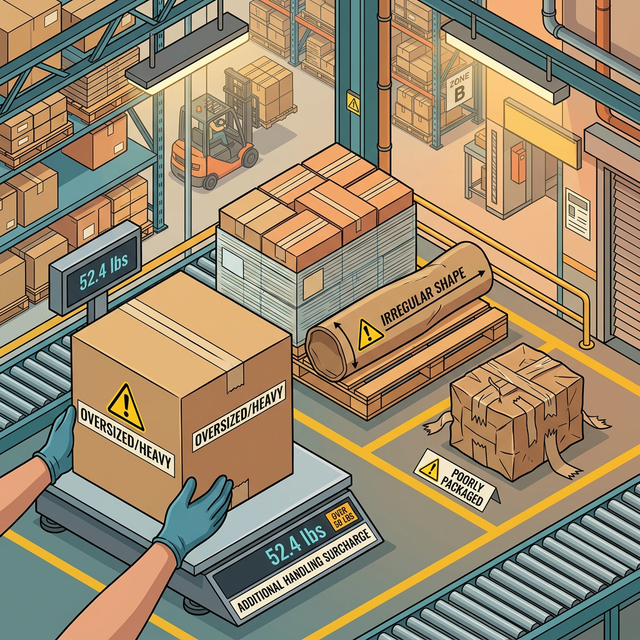
What Is an Additional Handling Surcharge?
An Additional Handling Surcharge (AHS) is a per-package fee that UPS and FedEx apply to packages that require extra care, equipment, or handling during sorting and transit. Unlike most surcharges, AHS can be triggered by three independent factors — and if multiple triggers apply, you may be charged for the highest one.
The Three AHS Triggers
1. Weight-Based AHS
Applied when the actual weight of a package exceeds the weight threshold.
| Carrier | Threshold | 2026 Surcharge |
|---|---|---|
| UPS | > 50 lbs | $33.00 |
| FedEx (Zones 2–6) | > 50 lbs | $33.00 |
| FedEx (Zones 7+) | > 50 lbs | $40.00 |
2. Dimension-Based AHS
Applied when any single dimension of the package exceeds the length threshold, or when the package’s second-longest dimension exceeds a shorter threshold.
| Carrier | Trigger | 2026 Surcharge |
|---|---|---|
| UPS | Longest side > 48” OR second-longest > 30” | $33.00 |
| FedEx (Zones 2–6) | Longest side > 48” OR second-longest > 30” | $26.50 |
| FedEx (Zones 7+) | Longest side > 48” OR second-longest > 30” | $33.75 |
3. Packaging-Based AHS
Applied when a package is not in a standard corrugated cardboard box — including cylinders, metal containers, wood crates, or items wrapped in plastic without an outer box.
| Carrier | Trigger | 2026 Surcharge |
|---|---|---|
| UPS | Non-standard packaging | $33.00 |
| FedEx (Zones 2–6) | Non-standard packaging | $26.50 |
| FedEx (Zones 7+) | Non-standard packaging | $33.75 |
How AHS Stacks with Other Charges
AHS is applied per package in addition to all other charges. A heavy, residential, DAS delivery accumulates surcharges quickly:
Example: 55 lb package to a rural residential address
| Charge | Amount |
|---|---|
| Base rate (Ground, 55 lbs, Zone 5) | $38.50 |
| Fuel surcharge (8.5%) | $3.27 |
| Residential delivery | $6.95 |
| Delivery Area Surcharge | $4.00 |
| Additional Handling (weight) | $33.00 |
| Total | $85.72 |
The AHS alone represents 38% of the total charge in this scenario.
Industries Most Affected by AHS
AHS tends to hit specific industries disproportionately:
- Furniture and home goods — Large, heavy items triggering both weight and dimension AHS
- Fitness equipment — Heavy dumbbells, benches, and machines
- Auto parts — Large bumpers, hoods, and heavy engine components
- Building materials — Long lumber, pipe, and heavy hardware
- Musical instruments — Large cases exceeding dimension thresholds
How to Avoid or Reduce AHS Charges
1. Stay Under the Thresholds
The most direct approach: keep packages under 50 lbs and under 48” on the longest side.
- Split heavy orders into two packages that each stay under 50 lbs
- Reduce packaging dimensions through tighter fitting boxes
- Use telescoping boxes for long items to reduce the longest dimension
2. Negotiate AHS Rates
AHS is negotiable in carrier contracts, particularly for shippers who frequently trigger it:
| Published | Negotiated (example) | Savings |
|---|---|---|
| $33.00 | $22.00 | 33% |
| $40.00 (Zone 7+) | $28.00 | 30% |
3. Request AHS Waivers
Some carrier agreements include waivers that eliminate AHS entirely for certain trigger types. For example, you might negotiate a weight-based AHS waiver if your products inherently weigh over 50 lbs.
4. Re-Evaluate Your Packaging
If packaging-based AHS is an issue:
- Switch from metal or plastic containers to corrugated boxes
- Add an outer corrugated box around non-standard items
- Use carrier-approved packaging to avoid the packaging trigger
5. Consider Freight for Heavy Items
For packages consistently over 50 lbs or 48” in any dimension, LTL freight may actually be cheaper than parcel shipping + AHS. The crossover point varies, but it’s worth comparing.
AHS vs. Oversize Surcharge
AHS and Oversize are different surcharges with different triggers:
| Additional Handling | Oversize | |
|---|---|---|
| Weight trigger | > 50 lbs | > 70 lbs (UPS) / > 110 lbs (FedEx) |
| Dimension trigger | Longest > 48” or 2nd longest > 30” | Length + girth > 130” |
| Typical charge | $26–$40 | $115–$150 |
A package can trigger AHS without being oversize, and an oversize package will typically incur the oversize surcharge instead of (not in addition to) AHS, since oversize is the more restrictive classification.
The Bottom Line
Additional Handling Surcharges are one of the most costly per-package fees in parcel shipping. At $26–$40 per package, even a small percentage of AHS-affected shipments can drive significant costs. The key is understanding which of the three triggers applies to your products and addressing each one — whether through packaging changes, order splitting, or contract negotiation.
Want to identify your AHS exposure? Upload one invoice to ShipMint’s Instant Analysis for a line-by-line surcharge breakdown — free.